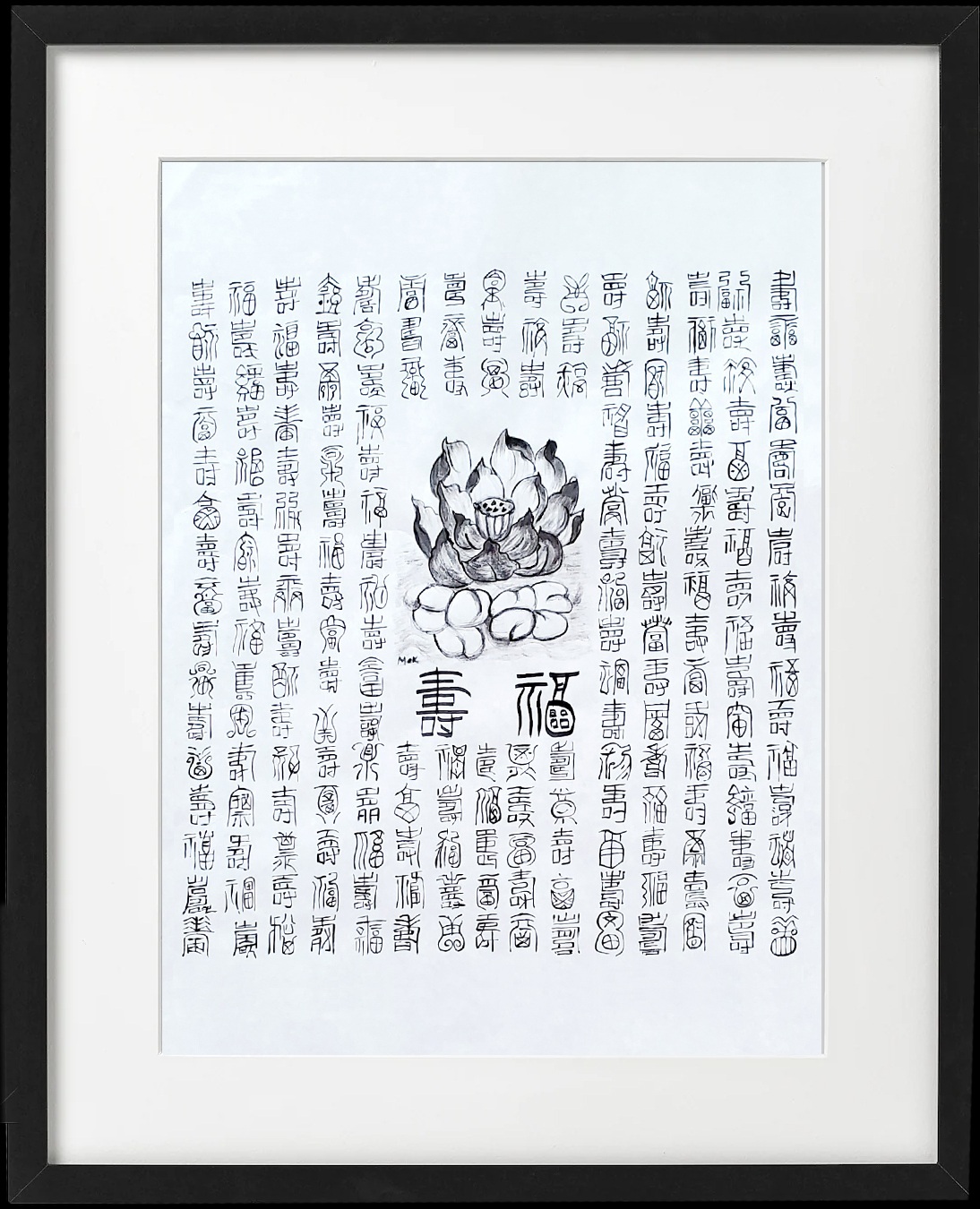
About Seal Script
Seal Scrip was first used during the Western Zhou Dynasty (about 1046 BC - 771 BC) during the Spring and Autumn Period.
In 221 BC, Seal Script became the font used by First Emperor Qin to unify the writing systems of the Six Kingdoms.
Later, the Seal Scrip was gradually replaced by the Clerical Script (Traditional and Simplified Chinese characters).
Today, most Chinese cannot read the seal script, so it is considered an ‘ancient’ script, generally not used outside the fields of calligraphy and carved seals.
IAW Wikipedia, “Seal script, also sigillary script (Chinese: 篆書; pinyin: zhuànshū), is an ancient style of writing Chinese characters that was common throughout the latter half of the 1st millennium BC. It evolved organically out of the Zhou dynasty bronze script. The Qin variant of seal script eventually became the standard, and was adopted as the formal script for all of China during the Qin dynasty. It was still widely used for decorative engraving and seals (name chops, or signets) in the Han dynasty.”
"The script of the Qin system (the writing as exemplified in bronze inscriptions in the state of Qin before unification) had evolved organically from the Zhou script starting in the Spring and Autumn periods. Beginning around the Warring States period, it became vertically elongated with a regular appearance. This was the period of maturation of the small seal script. It was systematized by Prime Minister Li Si during the reign of the First Emperor of China Qin Shi Huang through the elimination of most variant structures and was imposed as the nationwide standard. Through Chinese commentaries, it is known that Li Si compiled the Cangjiepian, a partially extant wordbook listing some 3,300 Chinese characters in the small seal script. Their form is characterized by being less rectangular and more squarish."
About the Autodidact
My name is Brenda. I’m a self-taught artist — an autodidact. In my spare time, I first picked up a brush in early 2022, practicing calligraphy as a way to deepen my understanding of Chinese. Painting came naturally a year later, in early 2023.
Why Ink, not color—because ink is black and paper is white. They form the most fundamental contrast, the origin of shape, and the quiet balance of existence. Within black and white lies the suggestion of all colors, yet none are imposed. Color can easily charm the eyes, but it can also distract the mind. Ink, by contrast, calls for stillness. It invites the viewer to slow down, to notice texture, movement, and the subtle shifts between emptiness and presence.
At first, my only goal was to master calligraphy: the discipline of stroke, structure, and rhythm. Each line demanded control, patience, and intention. But over time, I felt that pure calligraphy, though elegant, was too restrained for the emotions I hoped to express. The forms were precise, yet the imagery within me needed space to breathe.
Gradually, I began weaving ink painting into the calligraphic flow—letting strokes become landscapes, textures become motion, and empty spaces become atmosphere. I did not wish to abandon simplicity, only to deepen it. By adding just enough visual dimension—without relying on color—the work began to feel more alive. The ink remained honest, the paper remained pure, and within their dialogue, the art found its spirit.
I'm deeply grateful that calligraphy and ink painting have remained my passions—and that I've been able to cultivate some skill in them. This journey continues, one brushstroke at a time, and I'm excited to keep creating and sharing my art. If any of my pieces speak to you, I'd be honored for them to find a home with you. Feel free to reach out at brendamok8@gmail.com to discuss available works.
Personally I also like Photography
*Top